How Businesses Can Use GPT-6 Astra for Digital Marketing
Artificial intelligence is rapidly changing how businesses plan, create, execute, and measure their digital marketing activities. The arrival of GPT-6 Astra introduces another significant development, particularly for businesses looking to use AI for more than simple content generation.
OpenAI describes GPT-6 Astra as a model designed for complex professional work, with advanced capabilities in computer use, browsing, software engineering, writing, design, and multi-step workflows. It can work with applications people already use, including some workflows that do not require a dedicated API integration.
For businesses, this creates opportunities to use AI across different stages of digital marketing—from research and content planning to campaign analysis, website tasks, and repetitive marketing operations.
But how can businesses actually use GPT-6 Astra for digital marketing?
What Is GPT-6 Astra?
GPT-6 Astra is OpenAI’s latest generation of AI designed for complex work and advanced task execution. Unlike AI systems that are primarily used to generate text or answer questions, Astra is designed to handle multi-step workflows and interact with digital environments.
OpenAI highlights capabilities including computer use, web browsing, professional work, document creation, spreadsheets, presentations, coding, and website-related tasks.
For marketers, this means AI can potentially become part of the workflow rather than simply being a tool used to generate a paragraph or social media caption.
Businesses can explore GPT-6 Astra for tasks such as marketing research, content planning, website analysis, reporting, campaign workflows, and repetitive digital operations.
How GPT-6 Astra Can Help With Digital Marketing
1. Marketing Research and Strategy
Successful digital marketing begins with research.
Businesses need to understand their target audience, competitors, industry trends, customer problems, and search behavior before creating a marketing strategy.
GPT-6 Astra can assist with structured research workflows by gathering information, organizing findings, summarizing relevant material, and helping marketers identify patterns.
For example, a business could use AI to help research:
- Target audience characteristics
- Competitor positioning
- Customer pain points
- Content opportunities
- Industry trends
- Marketing channels
- Potential campaign ideas
The marketer can then review the information and use it to develop a more informed digital marketing strategy.
AI should support strategic decision-making rather than replace human judgment. Businesses should verify important information before using it in campaigns or customer-facing content.
2. SEO and Search Marketing
SEO remains an important part of digital marketing, but the process involves much more than inserting keywords into a page.
Marketers need to perform keyword research, understand search intent, analyze competitors, plan content, optimize pages, and monitor performance.
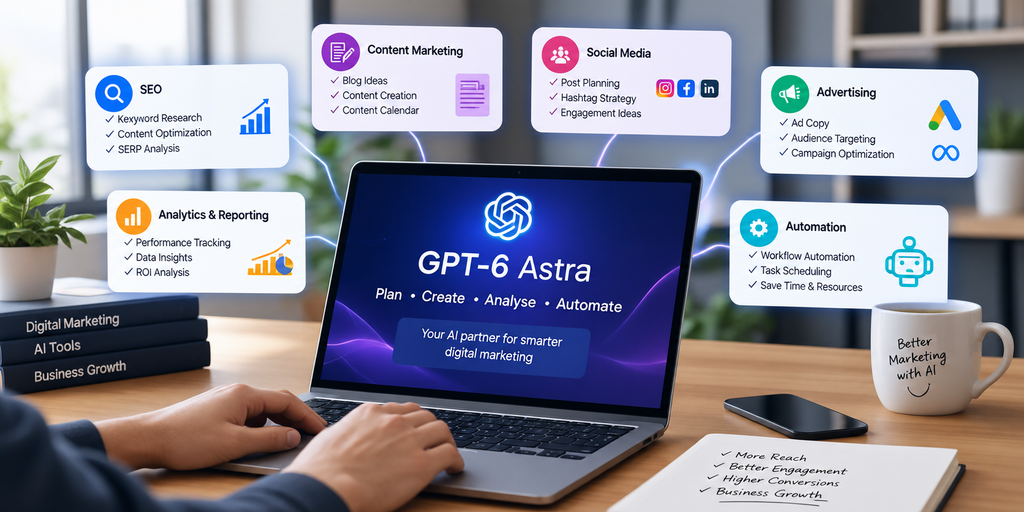
GPT-6 Astra can potentially assist with several parts of this workflow.
Businesses can use AI to help:
- Organize keyword research
- Group keywords according to search intent
- Develop content clusters
- Generate content briefs
- Analyze existing website content
- Identify potential content gaps
- Create SEO outlines
- Review on-page optimization
- Develop internal linking ideas
For example, instead of asking AI to simply “write an SEO article,” a marketer can provide a business goal and ask it to help structure a complete content workflow.
This approach makes AI for SEO more useful because the focus moves from producing text to supporting the broader SEO process.
Content marketing requires consistency.
3. Content Marketing
Businesses need blog articles, website copy, social media content, email campaigns, advertisements, landing-page copy, and other marketing assets.
GPT-6 Astra can help marketers organize and accelerate parts of this content workflow.
A business could use it to develop:
- Blog topic ideas
- Content calendars
- Article outlines
- Social media concepts
- Email campaign ideas
- Landing-page drafts
- Content repurposing plans
- Campaign messaging variations
For example, one long-form blog article could become several social media posts, an email topic, short-form content ideas, and additional supporting content.
However, businesses should maintain a consistent brand voice and review AI-generated content before publication. Original insights, real customer experiences, expertise, and accurate information remain important for building trust.
4. Social Media Marketing
Social media marketing involves continuous planning and execution.
Businesses need to identify content themes, prepare posts, respond to trends, analyze performance, and maintain consistency across platforms.
GPT-6 Astra can support marketers with content planning and repetitive digital workflows.
For example, businesses can use AI to help develop a monthly social media calendar based on:
- Business objectives
- Target audience
- Services
- Promotional campaigns
- Industry trends
- Content pillars
AI can also help marketers repurpose existing content into different formats.
A blog article could become a LinkedIn post, Instagram caption, carousel concept, or short-form video script.
The final creative direction should still be reviewed by the marketing team to ensure that the content reflects the brand accurately.
5. Google Ads and Paid Advertising
Paid advertising requires research, testing, optimization, and continuous analysis.
GPT-6 Astra can potentially assist marketers with parts of the advertising workflow, such as organizing campaign research, analyzing information, developing copy variations, and preparing reports.
Marketers could use AI to help with:
- Ad copy ideas
- Keyword organization
- Audience research
- Campaign planning
- Competitor research
- Performance summaries
- Landing-page analysis
- Testing ideas
However, AI-generated recommendations should not automatically be implemented.
Advertising budgets involve real money, so businesses should review campaign changes, targeting decisions, budgets, and performance data before making significant adjustments.
6. Website Optimization
A business website is often the foundation of its digital marketing strategy.
GPT-6 Astra’s computer-use and website-related capabilities create opportunities to assist with certain website workflows. OpenAI says Astra can create websites and perform frontend quality-assurance checks.
For businesses, this could support activities such as:
- Reviewing website content
- Identifying usability issues
- Checking page layouts
- Supporting website testing
- Reviewing conversion elements
- Analyzing landing pages
- Helping prepare website improvements
This can be particularly useful for businesses that regularly update landing pages or marketing websites.
Human review is still important, especially for changes involving website functionality, security, tracking, payments, or customer data.
7. Marketing Reporting and Data Analysis
Digital marketing generates large amounts of data.
Businesses need to understand metrics from websites, advertising campaigns, social media platforms, and other marketing channels.
AI can help turn complex information into easier-to-understand summaries.
GPT-6 Astra can potentially assist marketers in organizing data, identifying trends, creating reports, and explaining performance information.
For example, instead of manually reviewing multiple reports, a marketing team could use AI to help summarize:
- Traffic trends
- Lead generation
- Campaign performance
- Conversion data
- Content performance
- Customer acquisition activity
The marketer can then focus more time on interpreting the results and deciding what actions to take.
8. Automating Repetitive Marketing Tasks
One of the most interesting possibilities is using AI for repetitive workflows.
OpenAI describes GPT-6 Astra as capable of interacting with applications and performing multi-step computer tasks.
This opens opportunities for businesses to explore AI-assisted workflows such as organizing information, updating records, preparing documents, and completing repetitive digital tasks.
For a marketing team, reducing repetitive work can create more time for strategy, creativity, customer relationships, and campaign development.
However, automation should be introduced carefully. Businesses should define what AI is allowed to access and what actions require human approval.
Why GPT-6 Astra Matters for Small Businesses
Large companies often have dedicated marketing teams for SEO, content, advertising, analytics, and social media.
Small businesses may have only one person managing several of these responsibilities.
This is where advanced AI tools can become particularly useful.
GPT-6 Astra can potentially help small businesses organize marketing workflows, accelerate research, prepare content, analyze information, and reduce repetitive work.
The goal should not simply be to produce more content.
Instead, businesses should use AI to work more efficiently while maintaining quality and human oversight.
How Businesses Should Use GPT-6 Astra Responsibly
AI can improve productivity, but businesses should establish clear processes around its use.
Before allowing AI to perform marketing tasks, consider:
- Verify important facts and statistics.
- Review customer-facing content before publishing.
- Protect confidential business information.
- Avoid giving unnecessary access to sensitive systems.
- Require approval for important financial or advertising decisions.
- Maintain brand consistency.
- Monitor automated workflows.
- Keep humans involved in strategic decisions.
OpenAI has also highlighted safety improvements around browsing and workplace environments, including stronger resistance to prompt injection and unauthorized or destructive actions.
The Future of AI-Powered Digital Marketing
GPT-6 Astra represents a broader shift in how businesses can think about artificial intelligence.
AI is moving beyond simply answering questions and generating content toward assisting with complete workflows.
For digital marketers, this could mean spending less time on repetitive tasks and more time on strategy, creativity, customer understanding, and decision-making.
Businesses that learn how to combine AI capabilities with human expertise can create more efficient marketing processes without sacrificing authenticity.
The future of digital marketing is unlikely to be about choosing between humans and AI. Instead, it will increasingly involve finding the right balance between AI-powered efficiency and human creativity, judgment, and strategy.
Final Thoughts
GPT-6 Astra for digital marketing offers businesses new possibilities across SEO, content marketing, social media, advertising, website optimization, research, reporting, and workflow automation.
The biggest opportunity is not simply using AI to create more content. It is using AI to improve the entire marketing workflow.
For businesses, the practical approach is to start with repetitive and well-defined tasks, maintain human oversight, measure the results, and gradually expand AI-assisted workflows as the team gains experience.
AI can provide speed and scale, but a successful digital marketing strategy still depends on understanding customers, creating valuable experiences, building trust, and making informed decisions.